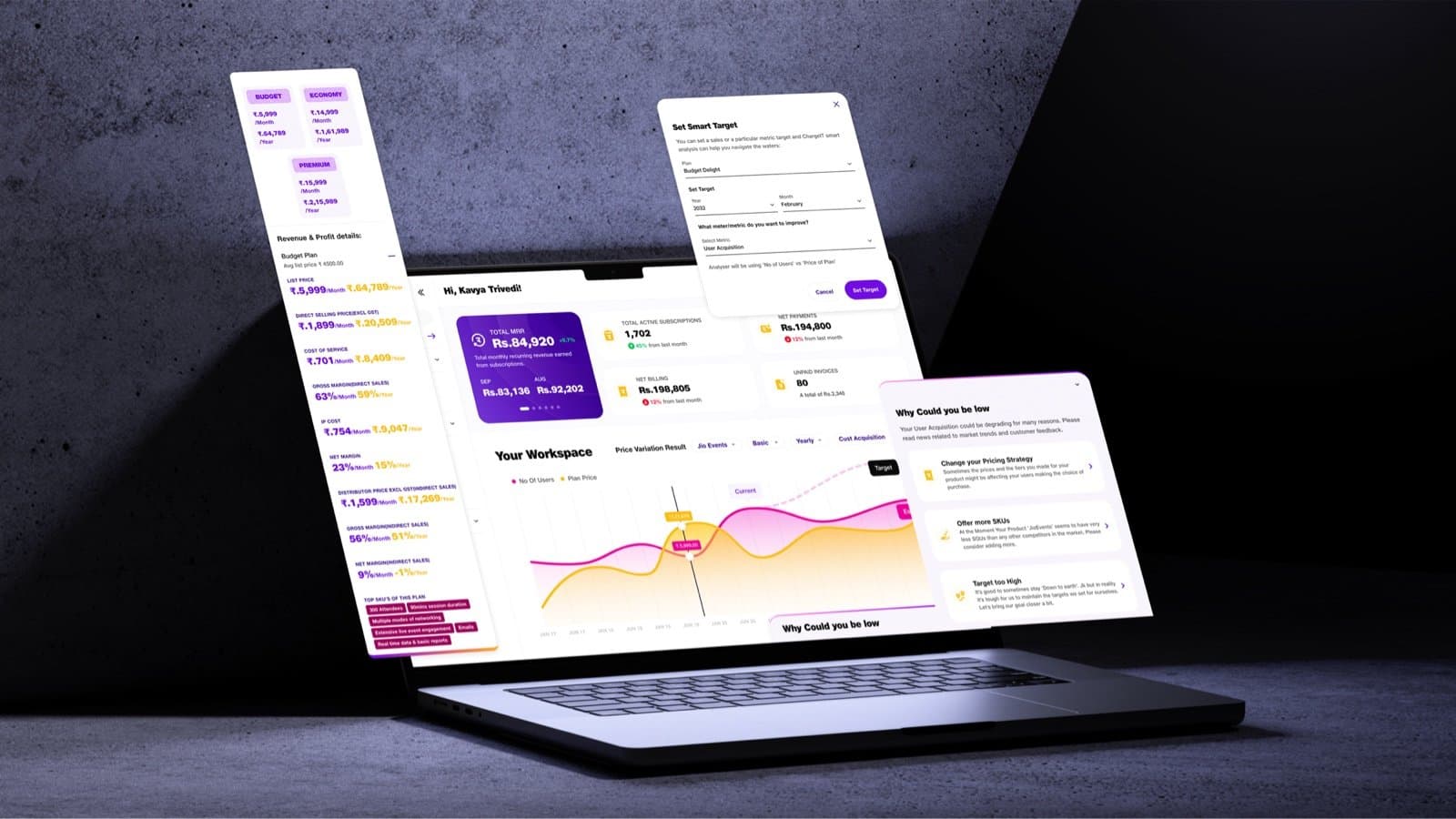
01 · Context
The engine worked. The product experience did not exist yet.
Jio had already tested a subscription engine through APIs. It could run recurring cycles, but the graphical management layer was still at an early stage. The team had a basic form for creating and editing plans, while much of the remaining work was handled from the backend.
That made plan creation the natural starting point. A plan is the foundation of a subscription business: it connects what is being sold to its billing frequency, currency, price, usage rules, and lifecycle. Improving this flow would also establish the interaction language for the rest of the product.
02 · Motivation
A billing error made the service problem tangible
Around the same time, I was renting furniture after moving to Hyderabad. A delivery-management issue led to an incorrect recurring charge for three months. Support eventually resolved it, but the experience made the cost of weak subscription operations concrete: a small mismatch can persist through every billing cycle.
This was a personal catalyst, not a substitute for user research. It helped me look beyond the plan-creation screen and frame ChargeIT as an operating layer for people who need to launch, change, price, and monitor subscription offerings without relying on backend intervention.
“Make complex subscription rules manageable without hiding the information operators need to compare and verify.”
03 · Product model
Plan creation had to carry the business logic
The automated engine handled recurring cycles, but the surrounding decisions still belonged to account owners and administrators. They needed to describe the offer, choose how it would be billed, configure currencies and frequencies, and understand how those choices worked together before publishing it.
I treated the plan as a composition of three layers: essential product information, advanced rules, and pricing. This reduced the apparent size of the task while preserving the depth required by an enterprise subscription system.
01
Basic
Name, product, plan type, and the information required to identify the offer.
02
Advanced
Optional controls and business rules that should not block the initial setup.
03
Pricing
Billing model, frequency, currency, usage unit, and the price the customer pays.
04 · First release
From one long form to a guided creation flow
The first redesign grouped the work into Basic, Advanced, and Pricing steps. It was a pragmatic intervention: improve the most important workflow quickly, establish a new visual direction, and create a base that could absorb more sophisticated pricing later.
Pricing was kept visible as a comparison surface. Frequencies and currencies appeared together, flags made enabled currencies easier to locate, and an operator could edit a price in context instead of opening another page for every variation.
05 · Pricing system
One pricing screen could not assume one pricing model
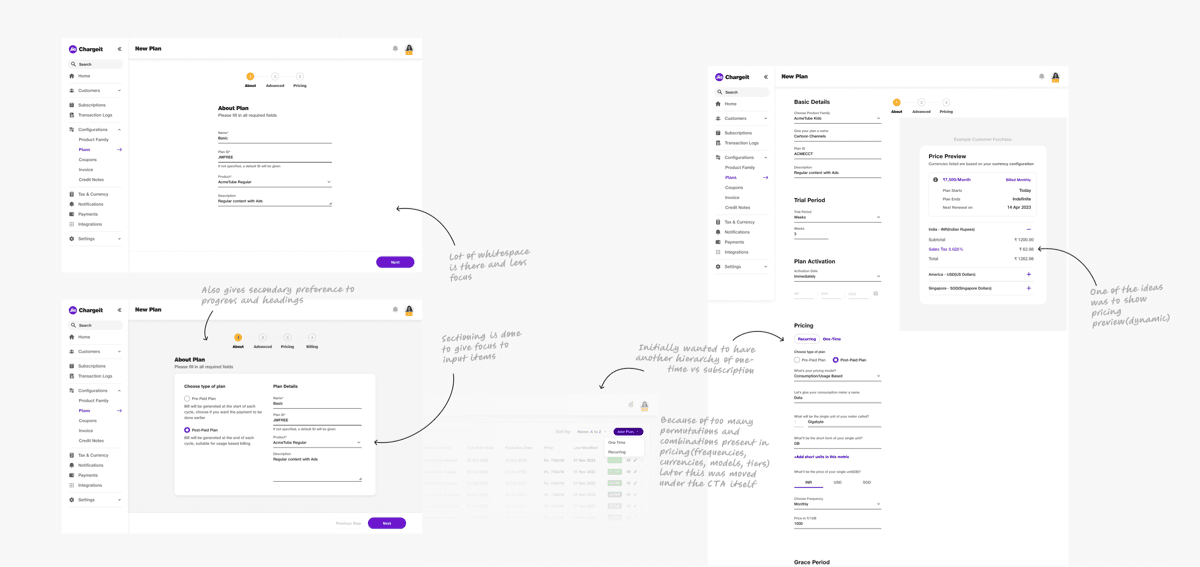
Secondary research and feedback from internal sales teams exposed the limitation of the first pricing direction. Supporting several currencies and billing frequencies was useful, but it did not cover how differently prepaid and postpaid businesses calculate value.
I mapped the recurring models the product would need to express, then reduced the design problem to three decisions: start with prepaid or postpaid, let the business define its own unit of consumption, and keep the operator in one coherent workspace instead of creating a separate interface for every model.
Pricing models considered
Freemium
Offer a basic service free and charge for premium capabilities or add-ons.
Flat rate
Charge one fixed price independent of usage.
Pay per quantity
Price by a known quantity such as seats or licences.
Per-unit
Define a fixed price for each unit consumed.
Volume-based
Change the unit price when usage reaches a volume threshold.
Tiered
Calculate portions of usage across multiple price ranges.
Fixed + consumption
Combine an included quota with metered overage.
Pay per active user
Charge only for licences that were active in the billing period.
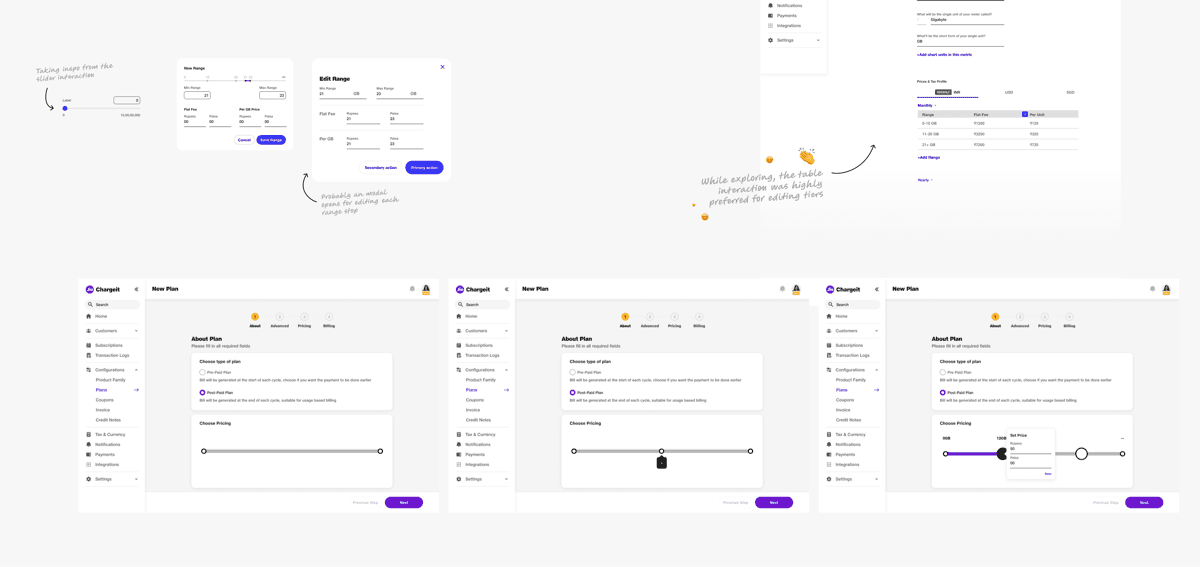
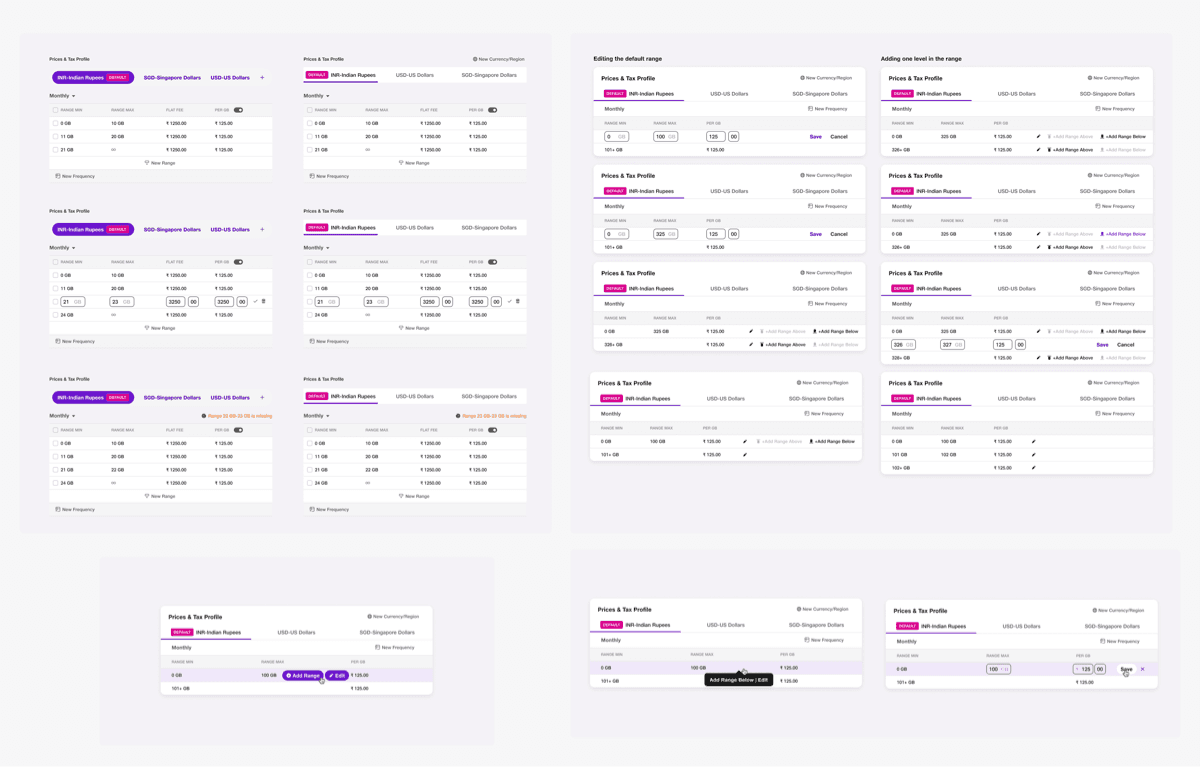
The hardest interaction was editing ranges and tiers while preserving frequency and currency context. The pricing table became the common surface for defining ranges, comparing variants, and making changes without losing sight of the complete model.
06 · Concept exploration
The larger delay happened before anyone opened the pricing tool
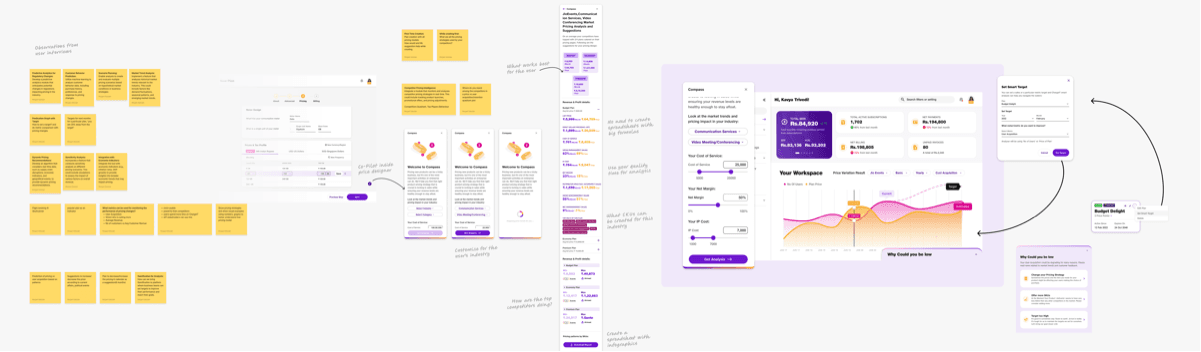
Conversations with internal sales colleagues showed that defining a pricing strategy could require competitor research, investment and margin inputs, revenue projections, and repeated stakeholder reviews. One colleague described spending close to two weeks researching and reviewing pricing approaches.
That led to Compass, a pricing-assistance concept rather than a shipped feature. The idea was to use a generative system to organise those inputs, surface comparable market information, and help teams explore the implications of a model before configuring it in ChargeIT.
07 · Looking back
What this work established
ChargeIT taught me to design the simple path and the underlying system at the same time. Grouping the initial form created immediate clarity, but the deeper value came from identifying a stable model that could absorb prepaid, postpaid, metered, multi-currency, and multi-frequency configurations.
Contribution
Plan-creation architecture, pricing interactions, postpaid model exploration, product identity, and launch illustrations.
Evidence boundary
This case study documents the design rationale and finalised direction. It does not claim measured launch-time or revenue impact.
Credits and collaboration
- The business team initiated the product and the API-based subscription engine.
- I was the sole designer responsible for clarifying the user-facing problem and designing the product experience.
- Product storylines were refined with the product team for the company-conference launch.
- Product-interface icons were created by the JioDesign Central team.